
Missional & Congregational Alignment
“Making disciples of Jesus Christ for the transformation of the world.”
THE UNITED METHODIST CHURCH
“Following Jesus, Thriving in Community, Healing the World.”
CALIFORNIA-NEVADA ANNUAL CONFERENCE
Missional & Congregational Alignment
There are so many needs in our communities. There are so many things we could be doing. It is important to discern whether a potential pilot program aligns with our mission and self-identity, even if it doesn’t explicitly invite people into our Methodist community.
One way to discern fit is to ask if this potential ministry is creating disciples either by new baptisms or by more deeply engaging current members in discipleship activities. Another way to discern fit to consider if an activity provides a way for people to follow Jesus, or thrive in community, or heal the world. Perhaps your congregation has a mission statement. Does this potential ministry align with that statement?
Beyond these missional litmus tests, “good fit” discernment can be found where our congregational self-identity and hopes meet community need and congregational assets and resources.
Close your eyes. Imagine the best-case scenario for your church in five years. What are the sights, sounds, and smells of this future community? Can you imagine this pilot ministry being part of that place in your imagination? If yes, you have probably found a fit.
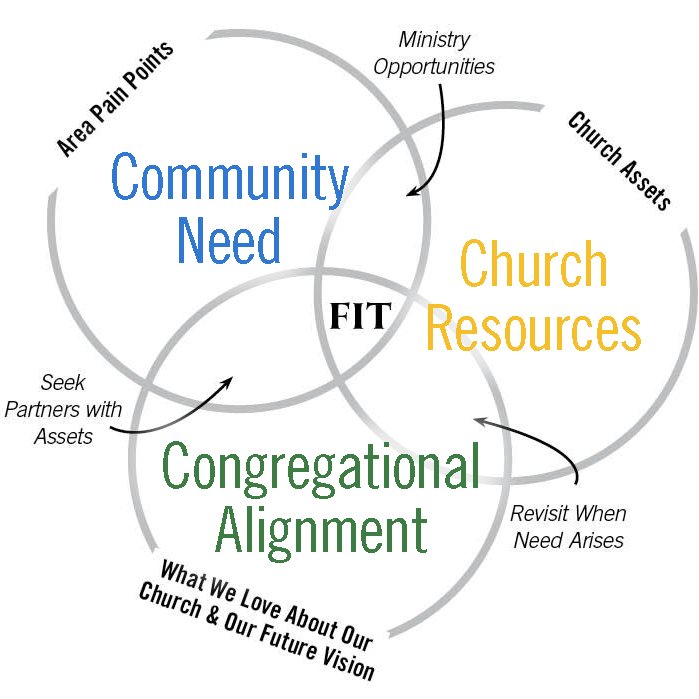
It’s Not Church
A common critique of ministries of transformational discipleship is that they are often work that any non-profit could do and are not connected to making disciples of Jesus Christ for the transformation of the world.
Anyone Could Do It
While anyone could do this work, if a church is picking it up, that indicates no one is doing this work. We can help. In helping, we knit ourselves back into communities that may consider us irrelevant.
Loving God and Neighbor
For us, the importance of the great commandment is made more obvious by serving broadly. As we demonstrate our commitment to our neighbors, our value as churches becomes more obvious. People begin to think about our churches as places that love both God and neighbor.
Wide Front Porch
A portfolio of new ministries helps a church build a wide front porch of prevenient discipleship opportunities open to all, as well as entry points into both traditional worship and into spiritual practice that may not resemble traditional worship experiences at all.
But It’s Not Boosting Worship Numbers!
No, it’s not. (At least not yet.)
We can assume that those not attending worship consider worship irrelevant to their lives. Even if the people we serve do not opt to join us in worship, transformational ministries provide discipleship opportunities for our members to serve our neighbors. Discipleship asks us to serve without agenda or expectation of reciprocation. Looking for a direct line from service to membership misses the point.
Again, transformational discipleship is about knitting a church back into the community from which it originally grew through relevant and helpful ministries. Successful ministry meet unmet community need. Let’s return the church to the heart of our neighborhood and community by reclaiming our space as a place of relevancy, connection, and safety. Only then might our worship services feel relevant to those outside our walls.