
Church Life Cycle
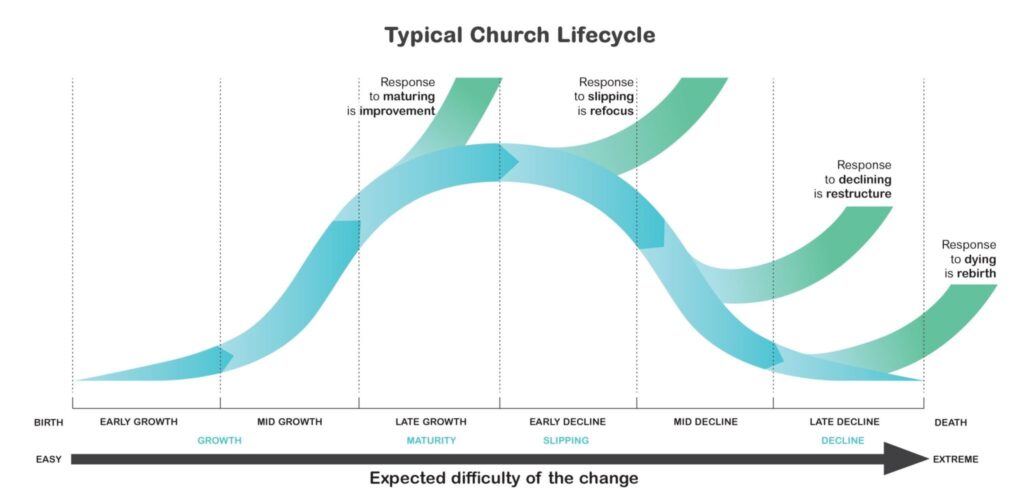
Ironically, our ability to take the many small risks required to continually return to a mid-growth church orientation is diminished in decline.
Early Growth
This stage is resource intensive and seemingly unimpressive to look at from the outside. Swift growth here is not always a good thing. Establishing scaffolding that can carry a church a ways is more important than a flood of folks who come into membership easily and leave just as quickly.
Mid Growth
Notice the hockey stick of swift membership growth. This is fueled by experimentation and a willingness to try many things even if they “fail.”
Late Growth
The plateau is a time of maturation with an emphasis on improving what works and continuing to allow emerging leaders to pilot new ministries to bring the church back into a mid-growth stage.
Early Decline
This stage can feature some frustration and finger-pointing. Refocusing on the systems established in late-growth is common, but refocusing on the patterns of experimentation at mid-growth is far more helpful for reenergizing a community.
Mid Decline
A swift slide membership, usually aligned with pastor-parish misfit, is a sign that people care more about the pastor than their church. It may be helpful here to restructure in such a way as to emphasise that members, not a pastor, drive a church. Allowing the laity to champion new ministries is a start.
Late Decline
A dying church is an opportunity for a radical replant. This is an excellent time to first assess congregational assets and resources and then to dream big.